Pacientes produtores ativos de saúde (prosumo)

Essa avalanche de informações e conhecimento relacionada à saúde e despejada todos os dias sobre os indivíduos sem a menor cerimônia varia muito em termos de objetividade e credibilidade. Porém, é preciso admitir que ela consegue atrair cada vez mais a atenção pública para assuntos de saúde - e muda o relacionamento tradicional entre médicos e pacientes, encorajando os últimos a exercer uma atitude mais participativa na relação. Ironicamente, enquanto os pacientes conquistam mais acesso às informações sobre saúde, os médicos têm cada vez menos tempo para estudar as últimas descobertas científicas ou para ler publicações da área - on-line ou não -, e mesmo para se comunicar adequadamente com especialistas de áreas relevantes e/ou com os próprios pacientes. Além disso, enquanto os médicos precisam dominar conhecimentos sobre as diferentes condições de saúde de um grande número de pacientes cujos rostos eles mal conseguem lembrar, um paciente instruído, com acesso à internet, pode, na verdade, ter lido uma pesquisa mais recente do que o médico sobre sua doença específica. Os pacientes chegam ao consultório com paginas impressas contendo o material que pesquisaram na internet, fotocópias de artigos da Physician's Desk Reference, ou recorte de outras revistas e anuários médicos. Eles fazem perguntas e não ficam mais reverenciando a figura do médico, com seu imaculado avental branco. Aqui as mudanças no relacionamento com os fundamentos profundos do tempo e conhecimento alteraram completamente a realidade médica. Livro: Riqueza Revolucionária - O significado da riqueza no futuro

Aviso!

Aviso! A maioria das drogas psiquiátricas pode causar reações de abstinência, incluindo reações emocionais e físicas com risco de vida. Portanto, não é apenas perigoso iniciar drogas psiquiátricas, também pode ser perigoso pará-las. Retirada de drogas psiquiátricas deve ser feita cuidadosamente sob supervisão clínica experiente. [Se possível] Os métodos para retirar-se com segurança das drogas psiquiátricas são discutidos no livro do Dr. Breggin: A abstinência de drogas psiquiátricas: um guia para prescritores, terapeutas, pacientes e suas famílias. Observação: Esse site pode aumentar bastante as chances do seu psiquiatra biológico piorar o seu prognóstico, sua família recorrer a internação psiquiátrica e serem prescritas injeções de depósito (duração maior). É mais indicado descontinuar drogas psicoativas com apoio da família e psiquiatra biológico ou pelo menos consentir a ingestão de cápsulas para não aumentar o custo do tratamento desnecessariamente. Observação 2: Esse blogue pode alimentar esperanças de que os familiares ou psiquiatras biológicos podem mudar e começar a ouvir os pacientes e se relacionarem de igual para igual e racionalmente. A mudança de familiares e psiquiatras biológicos é uma tarefa ingrata e provavelmente impossível. https://breggin.com/the-reform-work-of-peter-gotzsche-md/

terça-feira, 20 de janeiro de 2015

Consentimento Informado: Por Que e Como?

O texto acima se reflete ainda hoje na maneira de agir de muitos profissionais da Medicina que, aplicando cegamente os princípios Hipocráticos da Beneficência, buscam sempre o melhor para o paciente, mesmo agindo contra sua vontade.

Um caráter sobrenatural revestia o exercício da Medicina, fruto da pajelança e do curandeirismo, onde pajés, curandeiros e, posteriormente, os médicos, eram elevados a semideuses, por conhecerem ou, supostamente, dominarem os mistérios da cura.

Todavia, a evolução da Medicina e das leis que regulam as relações sociais está impondo mudanças nas relações entre médicos e seus pacientes.

Atualmente, verifica-se a busca pela efetividade dos direitos fundamentais individuais, dentre eles, a aplicação do princípio da autonomia, do qual decorre o direito de disposição do próprio corpo - autodeterminação, dentro dos limites legais.

Esta realidade é ratificada pelas disposições contidas no Código de Defesa do Consumidor, Código Civil, Código Penal e no próprio Código de Ética Médica. Ademais, os Tribunais brasileiros estão pacificados no sentido de garantir e defender o princípio da autonomia, bem como o direito à informação.

"E, não podemos falar em direito à informação e direito à autonomia, sem a prévia informação ao paciente e seu consentimento, comprovados pela materialização do Consentimento Informado"2.

http://www.rbcp.org.br/detalhe_artigo.asp?id=280

TERMO DE CONSENTIMENTO INFORMADO

TERMO DE CONSENTIMENTO INFORMADO


Pelo presente instrumento, declaro que fui suficientemente esclarecido (a) pelo (a) médico (a) (nome completo do médico) sobre os procedimentos (esclarecer quais procedimentos), a que vou me submeter, ou a que vai ser submetido (nome do paciente), do qual sou responsável legal, bem como do diagnóstico, prognóstico, riscos e objetivos do tratamento (discriminar).
Declaro também que fui informado (a) de todos os cuidados e orientações (discriminar) que devo seguir a fim de alcançar o melhor resultado. Estou ciente que o tratamento não se limita ao (colocar o procedimento realizado), sendo que deverei retornar ao consultório/hospital nos dias determinados pelo médico, bem como informá-lo imediatamente sobre possíveis alterações / problemas que porventura possam surgir.
Pelo presente também manifesto expressamente minha concordância e meu consentimento para realização do procedimento acima descrito.


Local e data
____________________________________________
Nome e assinatura do paciente (ou representante legal)
____________________
Documento de Identidade
______________________________
Testemunha

______________________________
Testemunha

quinta-feira, 15 de janeiro de 2015

Ex-diretor do DSM concede nova entrevista sobre livro que denuncia lobby da indústria farmacêutica

http://psibr.com.br/noticias/ex-diretor-do-dsm-concede-nova-entrevista-sobre-livro-que-denuncia-lobby-das-industrias-farmaceuticas

Traduzido para 12 idiomas, mas ainda em busca de editora no Brasil, o livro de Allen Frances “Saving Normal” (Salvando o normal, em tradução livre) questiona o manual que é referência para psiquiatras do mundo no diagnósticos de transtornos mentais. Para Frances, dificuldades diárias ganharam nomes de distúrbios no DSM (Manual Diagnóstico e Estatístico de Transtornos Mentais). Como resultado, uma legião de pessoas usa remédios sem necessidade, tendência que, ele diz, tem influência da indústria farmacêutica.
allen-normalTraduzido para 12 idiomas, mas ainda em busca de editora no Brasil, o livro de Allen Frances “Saving Normal” (Salvando o normal, em tradução livre) questiona o manual que é referência para psiquiatras do mundo no diagnósticos de transtornos mentais. Para Frances, dificuldades diárias ganharam nomes de distúrbios no DSM (Manual Diagnóstico e Estatístico de Transtornos Mentais). Como resultado, uma legião de pessoas usa remédios sem necessidade, tendência que, ele diz, tem influência da indústria farmacêutica.

O DSM 5, mais recente edição da “bíblia da psiquiatria”, é cercado de polêmicas, e uma delas veio do Instituto Nacional de Saúde Mental (NHI), um dos principais órgãos norte-americanos, que decidiu excluir de financiamentos as pesquisas que se baseiam nas categorias do guia. Especialistas como Frances — diretor da revisão da edição anterior a esta, o DSM IV — dizem que os critérios de diagnósticos são “frouxos” e podem sofrer pressões de setores interessados.
O senhor acredita num retrocesso do DSM 5 em relação do DSM IV?
Houve pouca controvérsia no DSM IV (1994) porque ele rejeitou 92 de 94 sugestões de novos diagnósticos. O DSM 5 (2013) é muito polêmico porque abriu as portas para a irresponsável abundância de diagnósticos e de venda de remédios.
Na sua opinião, novos transtornos foram incluídos sem necessidade no DSM 5? De quem é a responsabilidade?
Sim, estamos transformando os problemas diários em transtornos mentais e tratando-os com comprimidos. Parte do problema é que o sistema de diagnóstico é muito frouxo. Mas o principal problema é que a indústria farmacêutica vende doenças e tenta convencer indivíduos de que precisam de remédios. Eles gastam bilhões de dólares em publicidade enganosa para vender doenças psiquiátricas e empurrar medicamentos.
Quais seriam os exemplos desses excessos do manual?
Uma tristeza normal se tornou “transtorno depressivo maior”; um esquecimento da idade é “transtorno neurocognitivo leve”; birras usuais do temperamento infantil se tornam “transtorno disruptivo de desregulação do humor”; exagerar na comida virou “transtorno da compulsão alimentar periódica”; uma preocupação de um sintoma médico é “transtorno de sintoma somático”; e em breve todos terão “transtorno de déficit de atenção e hiperatividade” (TDAH) e tomarão estimulantes.
allen-normal-es
Tradução espanhola do livro"Saving Normal", de Allen Frances
Quando o psiquiatra Leon Eisenberg, considerado “o pai do TDAH”, se deparou com o aumento do diagnóstico nos EUA, ele o chamou de “doença fictícia”. Qual é a sua opinião?

O TDAH ocorre em 3% das crianças, mas é diagnosticado em 11% de americanos e, ridiculamente, em 20% de adolescentes homens. O remédio pode ser bom para poucos e terrível se usado em muitos.
Quão profundo pode ser o impacto de remédios desnecessários no comportamento desses indivíduos?
Fazemos um vasto e descontrolado experimento em nossas crianças, banhando seus cérebros imaturos com produtos químicos fortes sem saber seus efeitos de longo prazo. Pais precisam se tornar consumidores informados e proteger seus filhos.
A indústria farmacêutica exerce alguma pressão sobre o grupo de trabalho responsável pela revisão do DSM?
Ela espera às margens e não faz pressão na revisão de diagnósticos. Mas tem financiamento ilimitado e os melhores cérebros publicitários dedicados a difundir a desinformação de que transtornos psiquiátricos são subdiagnosticados e fáceis de diagnosticar. E apresenta comprimidos como solução.
Temos dados científicos suficientes para embasar os diagnósticos?
Aprendemos muito sobre o funcionamento do cérebro, mas até agora isso não ajudou um único paciente. O cérebro é a coisa mais complicada que existe. A passagem da ciência básica para a prática clínica é dolorosamente lenta, e não podemos nos apressar na psiquiatria. Ainda não temos testes biológicos para definir doenças mentais, mas isso não significa que não podemos ajudar aqueles que realmente precisam.
Como balancear a crítica ao excesso de diagnóstico sem elevar o preconceito com os doentes?
Enquanto tratamos em excesso os que não precisam, vergonhosamente deixamos os doentes de verdade ao léu. Temos ferramentas para ajudá-los a ser produtivos e ter dignidade.
Quais são as consequências disto?
Os gravemente doentes terminam na rua, em prisões ou hospitais psiquiátricos inadequados. Precisamos focar nos que estão doentes e proteger os que acham que estão. Nos EUA, pessoas morrem mais por remédios prescritos do que de drogas ilícitas.
Que medidas sociedade, cientistas, autoridades e indústria farmacêutica poderiam tomar?
Apertar o sistema de diagnóstico; recapacitar médicos para os riscos, e não apenas os benefícios de remédios; eliminar a propaganda de companhias farmacêuticas. É uma batalha de Davi contra Golias, mas foi bem-sucedida contra a indústria do tabaco.

domingo, 11 de janeiro de 2015

Novo Medicamento injetável para a esquizofrenia

http://entendendoaesquizofrenia.com.br/website/?p=4716

Novo Medicamento injetável para a esquizofrenia

Chega no Brasil este mês um novo medicamento injetável de depósito para tratamento da esquizofrenia. A substância é a Paliperidona, que já é comercializada no Brasil sob forma de comprimidos orais com o nome de Invega (laboratório Janssen Cilag). Trata-se de um antipsicótico de segunda geração, classe mais moderna de antipsicóticos que possuem menos efeitos colaterais, como a síndrome parkinsoniana, caracterizada por tremores, lentidão motora e psíquica, dentre outros sintomas.
A injeção, para ser administrada uma vez por mês, dispensa o uso diário de comprimidos e é uma opção para pacientes que não aderem bem aos medicamentos orais ou se recusam a fazer o tratamento.
Estudos têm demonstrado que as recaídas da esquizofrenia e a demora em atingir a remissão dos sintomas estão associados a um pior prognóstico e à cronificação e deterioração clínica do paciente.
Até então o único antipsicótico injetável de depósito de segunda geração disponível era a Risperidona (Risperdal Consta), que exigia injeções quinzenais. O Invega Sustenna, marca da Paliperidona de depósito, terá a vantagem do uso único mensal e de ser melhor tolerado do que a Risperidona.
Outros antipsicóticos de depósito (de primeira geração) disponíveis, como o Decanoato de Haloperidol, o Enantato de Flufenazina, a Pipotiazina e o Decanoato de Zuclopentixol, não são tolerados por muitos pacientes por possuírem mais efeitos colaterais do tipo parkinsoniano quando comparados aos antipsicóticos de segunda geração.
O custo do Invega Sustenna será alto, assim como os demais antipsicóticos de segunda geração, porém existe a possibilidade de ser coberto por planos de saúde se o paciente estiver em tratamento no hospital-dia. Por ser uma medicação nova, ainda não foi incorporada ao SUS, como já ocorre com outros antipsicóticos de segunda geração através do programa de dispensação de medicamentos especiais do Ministério da Saúde (guias LME).
Escute a entrevista do psiquiatra Rodrigo Bressan, coordenador do Programa de Esquizofrenia da UNIFESP (PROESQ), na Rádio CBN.


terça-feira, 25 de novembro de 2014

Are All Psychiatric Drugs Too Unsafe to Take? Answer: Yes

http://www.cchrint.org/2014/11/25/are-all-psychiatric-drugs-too-unsafe-to-take-answer-yes/


Are All Psychiatric Drugs Too Unsafe to Take? Answer: Yes


psychiatric-drug-side-effects-unsafe-to-take

“All classes of psychiatric drugs can cause brain damage and lasting mental dysfunction when used for months or years. Although research data is lacking for a few individual drugs in each class, until proven otherwise it is prudent and safest to assume that the risks of brain damage and permanent mental dysfunction apply to every single psychiatric drug.” — Peter Breggin, psychiatrist
Natural News – November 25, 2014
By Peter Breggin
Psychiatric drugs are more dangerous than you have ever imagined. If you haven’t been prescribed one yet, you are among the lucky few. If you or a loved one are taking psychiatric drugs, there is hope; but you need to understand the dangers and how to minimize the risk.

The following overview focuses on longer-term psychiatric drug hazards, although most of them can begin to develop within weeks. They are scientifically documented in my recent book Psychiatric Drug Withdrawal and my medical text Brain-Disabling Treatments in Psychiatry, Second Edition.

Newer or atypical antipsychotic drugs: Risperdal, Invega, Zyprexa,Abilify, Geodon, Seroquel, Latuda,Fanapt and Saphris

antipsychotics
Antipsychotic drugs, including both older and newer ones, cause shrinkage (atrophy) of the brain in many human brain scan studies and in animal autopsy studies. The newer atypicals especially cause a well-documented metabolic syndrome including elevated blood sugar, diabetes, increased cholesterol, obesity and hypertension. They also produce dangerous cardiac arrhythmias and unexplained sudden death, and they significantly reduce longevity. In addition, they cause all the problems of the older drugs, such as Thorazine and Haldol, including tardive dyskinesia, a largely permanent and sometimes disabling and painful movement disorder caused by brain damage and biochemical disruptions.

Risperdal in particular but others as well cause potentially permanent breast enlargement in young boys and girls. The overall risk of harmful long-term effects from antipsychotic drugs exceeds the capacity of this review. Withdrawal from antipsychotic drugs can cause overwhelming emotional and neurological suffering, as well as psychosis in both children and adults, making complete cessation at times very difficult or impossible.

Despite their enormous risks, the newer antipsychotic drugs are now frequently used off-label to treat anything from anxiety and depression to insomnia and behavior problems in children. Two older antipsychotic drugs, Reglan and Compazine, are used for gastrointestinal problems, and despite small or short-term dosing, they too can cause problems, including tardive dyskinesia.

Antipsychotic drugs masquerading as sleep aids: Seroquel, Abilify, Zyprexa and others

Nowadays, many patients are given medications for insomnia without being told that they are in fact receiving very dangerous antipsychotic drugs. This can happen with any antipsychotic but most frequently occurs with Seroquel, Abilify and Zyprexa. The patient is unwittingly exposed to all the hazards of antipsychotic drugs.

Antipsychotic drugs masquerading as antidepressant and bipolar drugs: Seroquel, Abilify, Zyprexa and others

The FDA has approved some antipsychotic drugs as augmentation for treating depression along with antidepressants. As a result, patients are often misinformed that they are getting an “antidepressant” when they are in fact getting one of the newer antipsychotic drugs, with all of their potentially disastrous adverse effects. Patients are similarly misled by being told that they are getting a “bipolar” drug when it is an antipsychotic drug.

Antidepressants: SSRIs such as Prozac, Paxil, Zoloft, Celexa, Lexaproand Viibyrd, as well as Effexor, Pristiq, Wellbutrin, Cymbalta and Vivalan

antidepressants
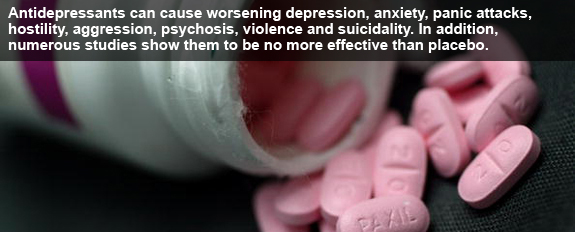
The SSRIs are probably the most fully studied antidepressants, but the following observations apply to most or all antidepressants. These drugs produce long-term apathy and loss of quality of life. Many studies of SSRIs show severe brain abnormalities, such as shrinkage (atrophy) with brain cell death in humans and the growth of new abnormal brain cells in animal and laboratory studies. They frequently produce an apathy syndrome — a generalized loss of motivation or interest in many or all aspects of life. The SSRIs frequently cause irreversible dysfunction and loss of interest in sexuality, relationship and love. Withdrawal from all antidepressants can cause a wide variety of distressing and dangerous emotional reactions from depression to mania and from suicide to violence. After withdrawal from antidepressants, individuals often experience persistent and distressing mental and neurological impairments. Some people find antidepressant withdrawal to be so distressing that they cannot fully stop taking the drugs.

Benzodiazepine (benzos) anti-anxiety drugs and sleep aids: Xanax,Klonopin, Ativan, Valium, Librium, Tranxene and Serax; Dalmane, Doral,Halcion, ProSom and Restoril used as sleep aids

anti-anxiety-dugs
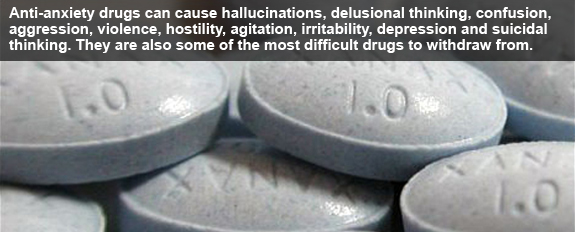
Benzos deteriorate memory and other mental capacities. Human studies demonstrate that they frequently lead to atrophy and dementia after longer-term exposure. After withdrawal, individuals exposed to these drugs also experience multiple persisting problems including memory and cognitive dysfunction, emotional instability, anxiety, insomnia, and muscular and neurological discomforts. Mostly because of severely worsened anxiety and insomnia, many cannot stop taking them and become permanently dependent. This frequently happens after only six weeks of exposure. Any benzo can be prescribed as a sleep aid, but Dalmane, Doral, Halcion, ProSom and Restoril are marketed for that purpose.

Non-benzo sleep aids: Ambien, Intermezzo, Lunesta and Sonata

These drugs pose similar problems to the benzos, including memory and other mental problems, dependence and painful withdrawal. They can cause many abnormal mental states and behaviors, including dangerous sleepwalking. Insufficient data is available concerning brain shrinkage and dementia, but these are likely outcomes considering their similarity to benzos. Recent studies show that these drugs increase death rate, taking away years of life, even when used intermittently for sleep.

Stimulants for ADHD: Adderall, Dexedrine and Vyvanse are amphetamines, and Ritalin, Focalin, and Concerta are methylphenidate

Ritalin pills and warning label.
All of these drugs pose similar if not identical long-term dangers to children and adults. In humans, many brain scan studies show that they cause brain tissue shrinkage (atrophy). Animal studies show persisting biochemical changes in the brain. These drugs can lead directly to addiction or increase the risk of abusing cocaine and other stimulants later on in adulthood. They disrupt growth hormone cycles and can cause permanent loss of height in children. Recent studies confirm that children who take these drugs often become lifelong users of multiple psychiatric drugs, resulting in shortened lifespan, increased psychiatric hospitalization and criminal incarceration, increased drug addiction, increased suicide and a general decline in quality of life. Withdrawal from stimulants can cause “crashing” with worsened behavior, depression and suicide. Strattera is a newer drug used to treat ADHD. Unlike the other stimulants, it is not an addictive amphetamine, but it too can be dangerously overstimulating. Strattera is more similar to antidepressants in its longer-term risks.

Mood stabilizers: Lithium, Lamictal, Equetro and Depakote

Lithium is the oldest and hence most thoroughly studied. It causes permanent memory and mental dysfunction, including depression, and an overall decline in neurological function and quality of life. It can result in severe neurological dilapidation with dementia, a disastrous adverse drug effect called “syndrome of irreversible lithium-effectuated neurotoxicity” or SILENT. Long-term lithium exposure also causes severe skin disorders, kidney failure and hypothyroidism. Withdrawal from lithium can cause manic-like episodes and psychosis. There is evidence that Depakote can cause abnormal cell growth in the brain. Lamictal has many hazards including life-threatening diseases involving the skin and other organs. Equetro cases life-threatening skin disorders and suppresses white cell production with the risk of death from infections. Withdrawal from Depakote, Lamictal and Equetro can cause seizures and emotional distress.

Summarizing the tragic truth

It is time to face the enormous tragedy of exposing children and adults to any psychiatric drug for months and years. My new video introduces and highlights these risks and my book Psychiatric Drug Withdrawal describes them in detail and documents them with scientific research.

All classes of psychiatric drugs can cause brain damage and lasting mental dysfunction when used for months or years. Although research data is lacking for a few individual drugs in each class, until proven otherwise it is prudent and safest to assume that the risks of brain damage and permanent mental dysfunction apply to every single psychiatric drug. Furthermore, all classes of psychiatric drugs cause serious and dangerous withdrawal reactions, and again it is prudent and safest to assume that any psychiatric drug can cause withdrawal problems.

Widespread misinformation

Difficulty in stopping psychiatric drugs can lead misinformed or unscrupulous health professionals to tell patients that they need to take their drugs for the rest of their lives when they really need to taper and withdraw from them in a careful manner. As described in Psychiatric Drug Withdrawal, tapering outside of a hospital often requires psychological and social help, including therapy and emotional support and monitoring by friends or family.

Meanwhile, there is no substantial or convincing evidence that any psychiatric drug is useful longer-term. Psychiatric drug treatment for months or years lacks scientific basis. Therefore, the risk-benefit ratio is enormously lopsided toward the risk.

Science-based conclusions

Whenever possible, psychiatric drugs should be tapered and withdrawn either as an inpatient or as an outpatient with careful clinical supervision and a support network as described in Psychiatric Drug Withdrawal. Keep in mind that it is not only dangerous to take psychiatric drugs — it can be dangerous to withdraw from them. The safest solution is to avoid starting psychiatric drugs! It is time for a return to psychological, social and educational approaches to emotional suffering and impairment.

sábado, 22 de novembro de 2014

BeyondMeds (Noruega)

http://beyondmeds.com/

About

BEYOND MEDS — ALTERNATIVES TO PSYCHIATRY — A RESOURCE
BeyondMeds-header1This blog documents and shares many natural methods of self-care for finding and sustaining health in body, mind and spirit. This blog also deals with wider issues in the socio/political and spiritual realms as they pertain to mental health and human rights issues surrounding psychiatry.
My own experience as both (now – ex) patient and a mental health professional allows for some interesting and sometimes uncomfortable insights into the mental health system in the United States.
The blog and the content has evolved over time. The archives reflect that.
For an introduction to the scope of this site in general there is a drop-down menu at the top of the page. I continue to work on presenting the archives for easy access. There are well over 4,000 posts on the blog now, many of which remain topical. It’s an ongoing job so the navigation menu is always under construction. Visiting often to check for additions.
This is a new article I highly recommend be read as an introduction to this blog: Stop taking your meds, right now… (NOT!)
A personal note to my readers — why I’m not available for correspondence..
~ ~
The archives of this blog now span close to five years. They are a record of a time in my life when I was learning and transforming at a rate unlike any other time in my life. I say this as a way of disclaimer. In the earlier years of this blog I am processing shock and dismay. In the early years I am undisputedly angry. I have worked out much of that and see things in a much less judgmental manner now. This continues to evolve. I sometimes want to take down old posts because they no longer convey how I feel, but I realize that they may still be helpful to people who are going through something similar now. The journey got me to where I am today, it’s just odd to have some of it in writing here for all to see.
See also: Who is this site for – Readers share what Beyond Meds has meant to them.
This blog began as a documentation of my journey off psychiatric medications. That thread remains as well.
This blog also serves as a source of critical information about psychopharmaceuticals. This aspect is not kept up to date as much as it was at one time but the archives remain full of such information.
Beyond Meds is not only for people who have been diagnosed as having bipolar disorder as the original URL seemed to suggest to some. As I say in my “Undiagnosing Myself” post I do not believe that the diagnosis of bipolar is terribly significant and I chose the original URL and original title of the blog to attract people who may have experiences like mine and believe themselves to be bipolar. (the current URL and title no longer reflect this, still many often consider, incorrectly, that this is a “bipolar” blog)
This blog may be appropriate for anyone with any psychiatric diagnosis. All diagnosis can potentially respond to natural treatments and alternative perspectives. The biopsych model is at best controversial. There are many different ways to consider difficulties of the psyche.
So it’s also possible for anyone to consider life without medication. This blog is a contemplation about healing ourselves through means other than medication whether you’re on medications or not. And I might add whether you choose to stay on them or not.
Along with documentation of my experience this blog covers the journeys to drug freedom of many other people as well as information and resources about alternatives to standard psychiatric care. It also covers the news about drugs that allow for consideration of other options. Often drugs are most useful in crisis, but not for long-term care. Once one is aware of options one has a real choice. I didn’t have such information to make a choice when I entered the mental health system. It’s my hope that I can help people see that there are choices and alternatives.
This site is in no way intended to be someone’s sole source of information for withdrawing from psych meds or for taking care of oneself with alternative means. I speak only from my own experience and am not offering advice that should be taken without professional help. That being said there is lots of information here that one could take to said professional. It is an unfortunate reality that most doctors know next to nothing about alternative treatments for psychiatric distress. I’ve had to educate my psychiatrist along the way and am grateful for his trust and respect.
My professional history:
I got my BA in Religious Studies at UC Berkeley. After graduation a San Francisco state MSW graduate friend of mine helped me secure an interview for a graduate internship program for social workers at San Francisco AIDS Foundation. After losing a close friend to AIDS I had worked in an AIDS hospice as a volunteer for a couple of years.  Once interviewed by the Foundation it was determined I was qualified to do the internship. I completed the program with social work graduate interns from UC Berkeley’s and San Francisco State University’s MSW programs. After that internship the San Francisco AIDS Foundation hired me on as a social worker on their front lines. The bulk of the population I worked with at the Foundation had significant psychiatric diagnosis. Later I took positions in mental health agencies. Because of my background my positions were generally filled by master level candidates. I worked side by side other social workers, therapists of all kinds and psychiatrists for many years. The clients were generally designated “severely mentally ill.”
My “patient” history:
The aftermath of polypsychopharmacology: my story on Dr. David Healy’s site (new) –this is the most complete short synopsis of having been grossly over-drugged and my path to drug freedom.
The above two pieces can serve as a mini history of my personal journey in and away from the psychiatric system.
For posts on Beyond Meds that are largely informed by my personal experience see:  Monica/Gianna personal journey
***The information provided on this site is educational and not intended to replace any treatment prescribed by a licensed physician. That said, finding knowledgable physicians can be like finding a needle in a haystack
Everyone’s journey to wellness includes different combinations of healing and healthy lifestyle practices. No two of us are the same.
Access to the archives can be found at the top of the blog via the drop down menus. 
Visit the Beyond Meds BOOKSTORE for books that cover the range of topics covered on the blog.

Navigate the archives: